
Please turn your device to portrait.
Australia’s existing homes average 1.8 energy stars while new builds must hit seven, yet window furnishings have never had an independent energy number to put in front of a customer. WSAA’s WincovER simulator, launched at SuperExpo 2026, delivers one. The implications run from the sales floor to national energy policy.
The figures at the heart of Australia’s energy efficiency debate are ones the window furnishings industry has struggled to enter. Across 11 million existing homes, the average energy star rating is 1.8. Every new build is now legally required to reach seven. “1.8 stars in 11 million homes and the government’s forcing all new homes to be at seven stars. Something’s amiss,” Jason Lewis, WSAA co-president, told delegates at the WincovER launch seminar during SuperExpo 2026 at the Gold Coast Convention and Exhibition Centre. On Tuesday of expo week, WSAA members received login credentials to the association’s new website with immediate access to the WincovER simulator. For the first time, a retailer can enter a postcode and a few home details, select a window furnishing, and return an independent energy-savings estimate and CO2 reduction figure, backed by the same calculation engine the Australian government uses for official home energy star ratings.
THE BUILDING SCIENCE
Dr Rebecca Powell, the scientist behind the simulator’s methodology, has worked with the association for nine years. At SuperExpo, she made the case in plain terms: windows are where a building’s energy budget leaks at scale.
“Windows are a real weakest link in the building fabric,” she told the seminar. “They’re very poor insulators compared to walls. So even though [windows are a small part of] your building, a really large amount of energy will flow through them, which is good for us because window furnishings can help.”
Window coverings save energy two ways: added insulation through a sealed air pocket, and reduced solar heat and light. The sealed air pocket is the key principle. “The very best way that a window covering can insulate the window is by creating a sealed air pocket over it,” Powell said, “like with a roller blind that has side channels, or a curtain that reaches to the floor and touches the edges of the pelmet over the top.”
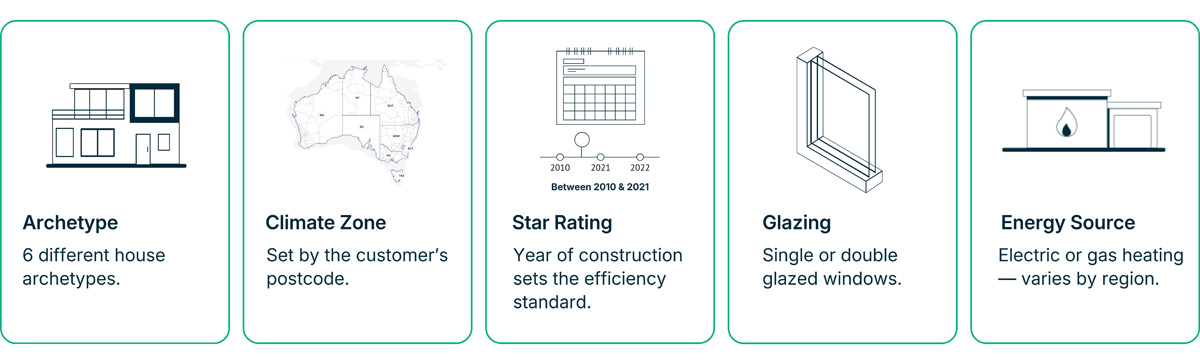
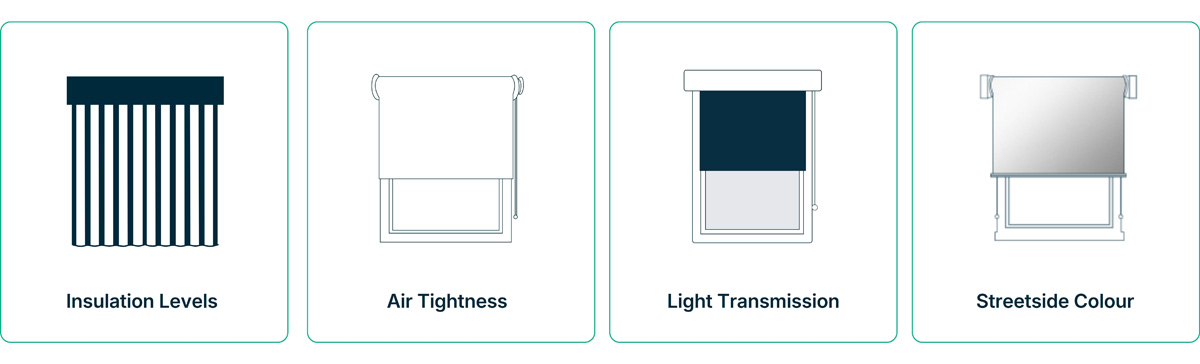
Translating that science into the simulator took more than a year. WincovER builds on a 2021 soft launch with Ozroll and Hunter Douglas that issued more than 4,000 certificates, Lewis told the seminar, after which the association moved away from testing every fabric individually toward a generic modelling approach. South Australian climate-technology firm Hubble ran more than 525,000 simulations across multiple housing archetypes and 19 Australian climate zones. In use, a retailer supplies five house inputs (archetype, postcode, construction period, glazing type and heating energy source) and four furnishing inputs (product type, mounting position, light transmission and street-side colour), which translate the characteristics that drive performance into everyday retail terms. Four archetypes are live now (single-storey brick veneer, single-storey double brick, double-storey, and apartment), with a duplex and a low-insulated weatherboard style expected within weeks. The archetypes are NatHERS government benchmarks, not replicas of the customer’s home. “It is intentionally generic. It’s a baseline,” Lewis told delegates.
WHAT THE NUMBERS SHOW
Results appear in two columns: manual and automated. Manual reflects the NatHERS default operating schedule (blinds up during the day, down at night), which suits Tasmania and Victoria. Automated models the optimal schedule for the property’s specific climate zone, and that gap is where motorisation makes its case. All savings are calculated against heating and cooling load only, which accounts for roughly half a home’s total energy consumption.
“We have an 11% saving on the heating and cooling load in the house,” Lewis demonstrated during a live run-through. “Put some motorisation and a time clock with them, or some home automation, and you can achieve up to a 21% saving on your heating and cooling.”
The difference matters because the NatHERS default is the wrong schedule for New South Wales and Queensland, where the more efficient approach is to block summer sun during the day and open at night for airflow. A motorised blind on a climate-optimised timer does this automatically.
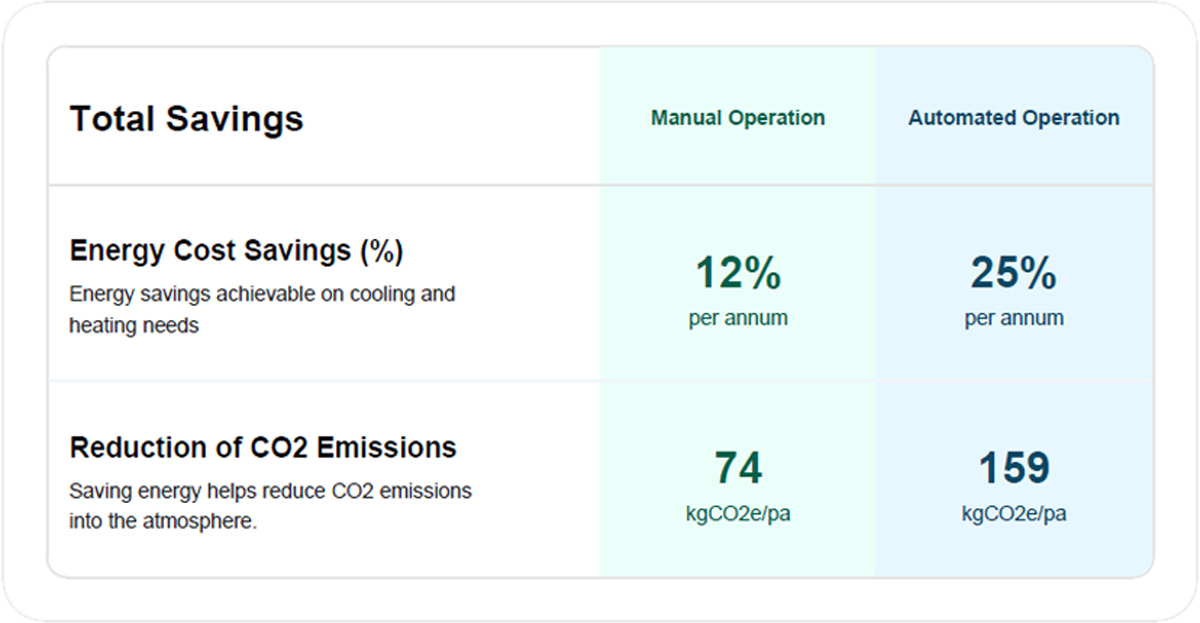
WSAA’s authoritative worked example covers a blockout roller installed whole-house in a double-storey, electrically heated Sydney home built between 2010 and 2021: 12 per cent energy cost savings and 74 kgCO2e per year on manual operation, rising to 25 per cent and 159 kgCO2e per year when automated.
External products go further still. The same Sydney home with an external roller blind returns 29 per cent cooling savings on manual operation and 45 per cent when automated, though NatHERS has no winter schedule for external products, so the simulator shows cooling savings only. “This tool is going to be phenomenal for us to go and talk to government,” Lewis said.
Retailers who work on individual rooms rather than whole houses can use a selected-windows option, added after focus groups with about 30 retailers earlier in 2026. “One of the biggest feedbacks was, we don’t do whole houses all the time,” Lewis told delegates. “The customer wants to buy just curtains in their bedroom or just blinds in their bedroom.”
THE CERTIFICATE AS A SALES TOOL
Each simulation produces a downloadable certificate, saved to the member’s WincovER portal and issuable directly to the customer. Crucially, the certificate is issued by the association’s software, not the retailer, so liability sits with WSAA rather than the person making the sale.
Lewis leaned on the manufacturers and wholesalers in the room to push the tool out to their retailers, arguing it will drive up the average dollar value of every furnishing they sell.
“If we’re doing a hundred jobs and it’s a two thousand dollar job for every single job, and we then move from a two thousand dollar job to a four thousand dollar job with the same amount of windows, that’s great for business. It’s much easier for us all to make money and we don’t have to increase the size of our teams.”
Differentiation follows the certificate. “If you’re the one in your local area who is providing the certificate, comparing same fabric, same manufacturer, same componentry, and you’re the one providing the additional information about the energy savings and the CO2 savings, you’re going to differentiate yourself enough that I think you’re going to be able to generate the sale.”
Merimy Bruens, owner of Beautiful Blinds, said climate-zone coverage is central to her national e-commerce model. “For me, understanding how WincovER works across different climate zones is really important. I run an e-commerce business selling cellular blinds right across Australia, being able to integrate that performance data is very beneficial.”
Danny Elassaad, managing director of CW Products, said wholesale suppliers now have a concrete reason to connect retail customers to the association. “The work WSAA has done here is stellar. As a wholesale supplier, we absolutely want to take the lead in encouraging our customers and connecting them to the association. WincovER gives us a genuine reason to do that.”
Access is member-only. The association offered 25 per cent off new memberships during SuperExpo week to accelerate uptake, and webinars are planned from August onwards to train retail sales teams. Lewis said the association is targeting API integration with industry quoting platforms, including Quoterite, in early 2027, which would let energy results be generated inside existing quoting workflows without running a separate system. A commercial-building mode is also on the roadmap.
FROM THE SHOWROOM TO CANBERRA
The commercial launch is also the foundation of a lobbying campaign. NatHERS has launched an existing-homes ratings scheme, currently in staged rollout, under which accredited assessors visit properties, rate them, and issue certificates that include tailored upgrade advice. WSAA has already drafted the window furnishings section of that upgrade path. “On the back of the certificate they give you the upgrade path,” Lewis told the seminar, “and they’re going to have a section which we’ve already done all the wording for: the upgrade path for window furnishings.”
Further along the advocacy horizon is a push for rebates. Lewis is explicit that this is long-term aspiration, not existing policy. “I can see a world with this tool where we can lobby governments and say we want a four thousand dollar allowance for window furnishings, so the ten thousand dollar job becomes six thousand dollars for our customers. They’re already doing it in Victoria for rentals.”
The ultimate goal is more ambitious. “Ultimately, I would like to see window furnishings included as part of a certificate of occupancy. I think that would be the ultimate goal,” Lewis said. “Rebecca tells me that’s going to take ten years, so I might have to change the constitution, because I’m not leaving until I get it done.”