
Please turn your device to portrait.
After 40 years developing Excel-based tools for Blindware and Turnils, Grant Norton has launched Blind.Expert, a subscription platform delivering sophisticated bill-of-materials calculators, fabric nesting optimisers, and machinery integration for $59.95 per month. WFA examines why he chose spreadsheets over SaaS, and what it means for small operators priced out of traditional ERP systems.
Every mid-size window furnishings business knows the calculation. Enterprise resource planning systems cost $400 to $600 per month at entry level, often with setup fees reaching thousands. Excel is free, but building sophisticated tools requires technical skills most operators don’t have. The gap in between has been largely ignored.
Grant Norton spent four decades building Excel-based tools for Blindware and Turnils, tube strength analysers, booster spring calculators, bill-of-materials systems for rollers, venetians, shutters and curtain tracks. When he left to establish Blind.Expert two years ago, he brought that institutional knowledge with him, along with a deliberate pricing strategy: $59.95 per month for three users, with access to the entire workbook library.
“Many smaller business operators just can’t afford the entry level cost of $400 to $600 per month charged by many of the established ERP providers,” Norton says. “They don’t have a tech stack that can simplify their business, saving them wasted time and wasted materials.”
“Many will just use the prices set by larger competitors, which they simply match or under-cut. The problem is that these companies don’t then tie those ‘market’ selling prices back to their actual costs and could be selling products at a loss.”
The platform’s positioning is deliberate: Blind.Expert doesn’t compete with ERP systems like BlindMatrix, Quoterite or Buzz. Instead, Norton describes it as operating “upstream”, the workbooks create grid price matrices that become inputs to ERP systems, perform fabric and profile nesting to maximise yields, and export directly to Ultracut machinery via USB with nesting applied.
“We generally operate upstream of ERP systems, providing valuable inputs to enable them to operate,” Norton explains. “We also provide many functions that are not supported by ERPs, such as export of the blind skins direct to Ultracut machinery on a USB drive, with a nesting step in between. As far as I know, no ERP systems offer that level of functionality.”
The Grid Pricing Problem
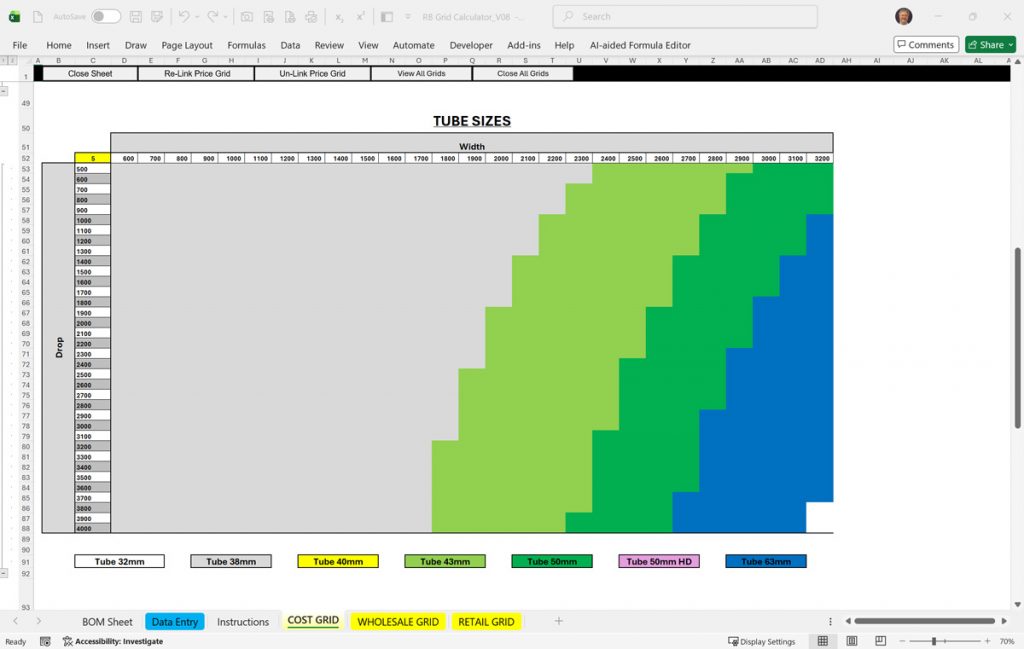
Norton’s grid pricing calculator addresses a fundamental business risk in the blind industry: manufacturers copying competitor pricing without understanding their own costs.
“Over the years, I have seen manufacturers (large and small) working with very basic and sometimes inaccurate systems to calculate their grid prices,” he says. “In fact, many will just use the prices set by larger competitors, which they simply match or under-cut. The problem is that these companies don’t then tie those ‘market’ selling prices back to their actual costs and could be selling products at a loss.”
“With our Curtain workbook, you can simply enter your project, press the button and watch the workbook do it all for you. When the ‘Curtain Person’ is not there, everything doesn’t stop.”
Using proper systems, Norton argues, empowers manufacturers to understand margins and focus on driving costs down through technology, better purchasing and improved productivity, rather than blindly following market pricing.
The “curtain person” risk
Norton’s curtain bill-of-materials calculator emerged from conversations with fabricators who revealed a striking single point of failure.
“When I was talking to people in the curtain side of the industry, I was surprised how few systems existed in most businesses,” he says. “In many, there was a ‘curtain person’ who does it all. When they were not there, everything stopped.”
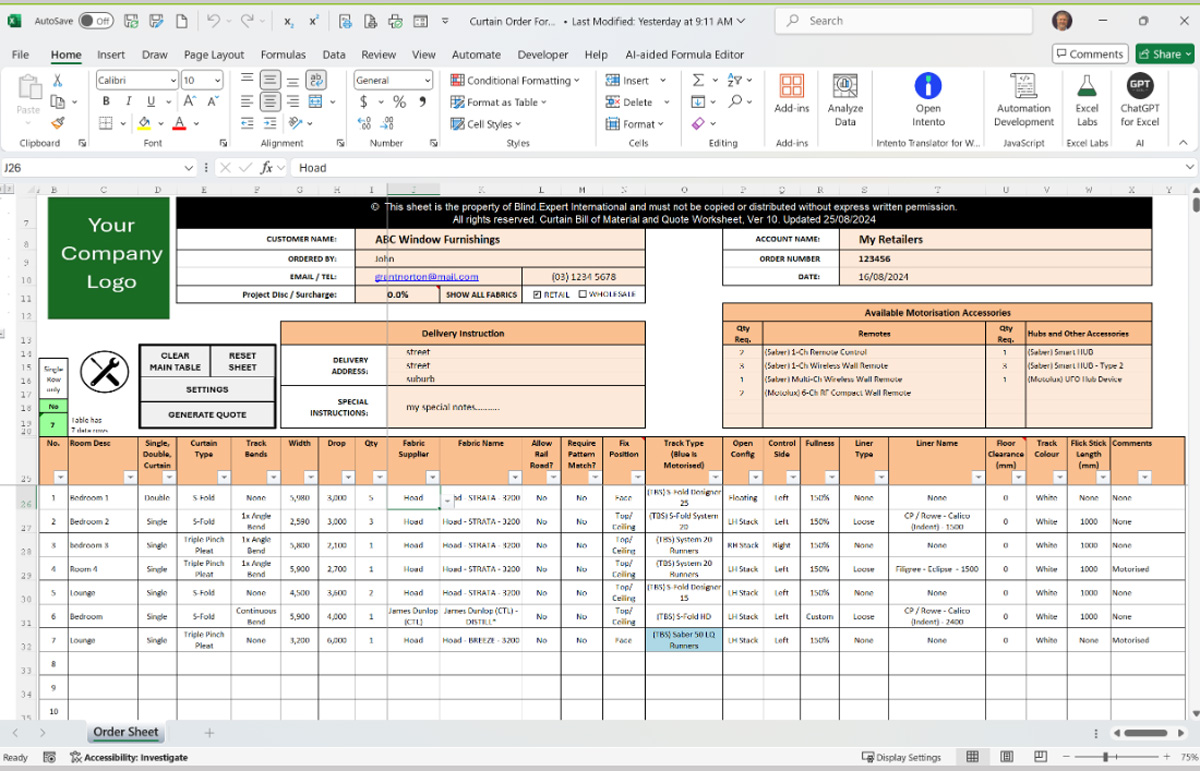
The curtain workbook, which Norton describes as one of his most advanced to date, developed with guidance from Bruce Habib at Sharon’s Curtains, handles projects of any size, itemising curtain details, fabrics, tracks, motorisation, stack and control sides, fullness and pattern matching. The system performs complex bill-of-materials calculations for every curtain in a job, optimising and aggregating fabric, track and consumables usage.
“It takes away the guess work, providing a fast and accurate assessment of total materials usage, along with total costs and margins,” Norton says. “It allows for panel cut and continuous fabrics, all header and seam allowances, COM fabric manufacturing, or complete in-house production.”
The workbook produces fully formatted quotes, track purchase orders and fabric take-offs for entire jobs, functionality Norton says he hasn’t seen elsewhere at comparable cost.
Why Excel?
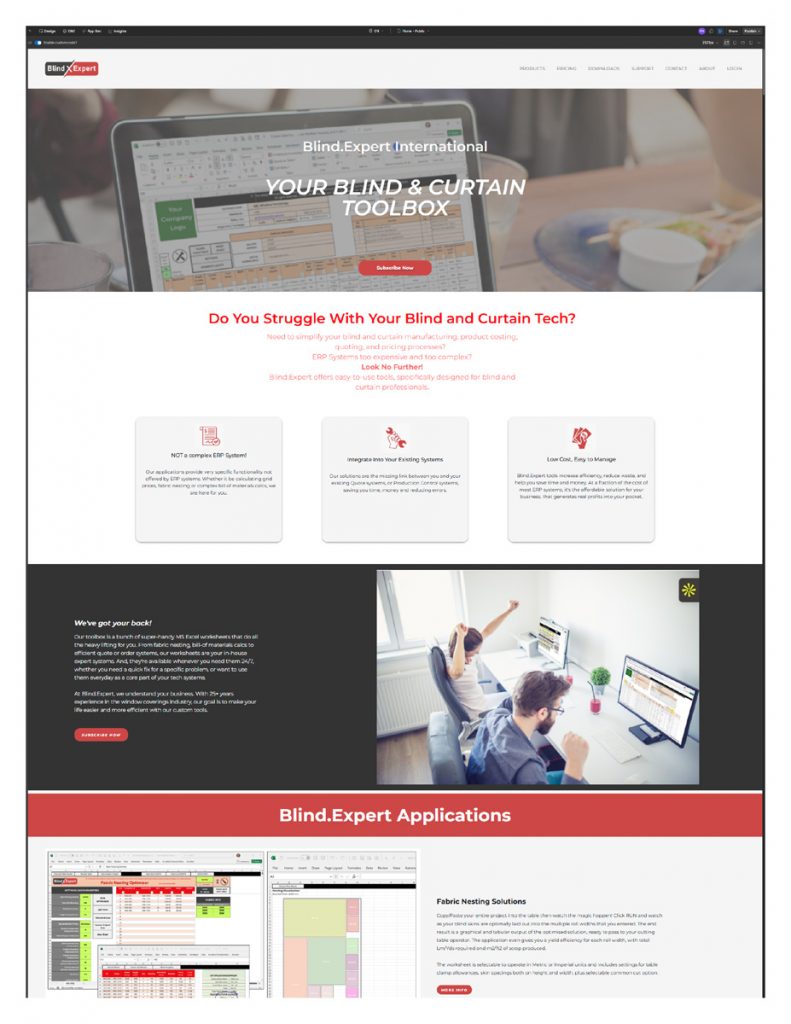
Norton’s choice to build on Excel rather than create cloud-native SaaS surprised some industry observers, but the 40-year Excel developer is unapologetic.
“I bought my first PC around 1988, a 386 Laptop running Lotus-123 and very early Excel,” he says. “That’s nearly 40 years ago and I have been doing Excel development in almost every business role since then.”
“One of the greatest benefits I provide to users is they can upload their own content, like fabric lists, new track supplier data, new component supplies. This is generally not possible with many SaaS systems.”
The architecture delivers specific advantages for users. Workbooks download to local machines and run on Microsoft 365 without requiring internet access, they handshake with the cloud but can detect offline status and allow four to five file opens before requiring connection verification.
“Almost everyone knows how to drive Excel at some level, so entering data, updating supplier tables etc is almost second nature to many,” Norton explains. “One of the greatest benefits I provide to users is they can upload their own content, like fabric lists, new track supplier data, new component supplies etc. This is generally not possible with many SaaS systems, as the backend is usually locked, causing much frustration for users who wait weeks for data uploads, with some ERP companies charging hundreds and (I am told) even thousands an hour to perform specialist work.”
User data can be easily backed up to desktop and restored when updated sheets are downloaded. Quote registers enable efficient follow-up and recall for editing. Cloud connectivity notifies users when workbook updates are available.
Ultracut Integration
Direct machinery integration developed from a Melbourne manufacturer’s request and subsequent conversations with Ultracut’s Garth, who reported multiple customer requests for that capability.
Norton built several levels of integration. Basic workbooks convert blind details to export files for direct upload to cutting tables. Advanced versions add nesting, orders sorted by fabric and roll width, efficiently nested into available roll options, then exported to USB for upload in optimised sequence.
“That is a huge step, as it ensures the cutting table process is standardised,” Norton says. “The yield you achieve from fabric rolls is not determined by an operator who might be having a good or bad day.”
“I am scaling this for subscriber numbers to reach into the thousands. The entry level subscription of $59.95 was deliberately set to be accessible for small business owners, like retailers and decorators.”
The top-tier application combines comprehensive roller blind cost calculator and quote sheet with full nesting and export functionality, all available from the Blind.Expert website.

The AI reality check
While Blind.Expert incorporates AI chatbots for user support, Norton’s assessment of artificial intelligence is notably measured compared to broader industry hype.
“Like many people, I certainly use AI as an aide for coding, but I find it has a limited attention span, makes mistakes and gives false assurances that it ‘has it right this time’,” he says. “AI helps, but it’s not the entire answer and requires a lot of human sanity checking.”
Global ambitions
International scaling is built into the platform’s architecture. Many workbooks are produced in metric and SI units with user-selectable currency symbols for quotes and purchase orders. The website supports multiple languages, with plans to introduce selectable language options inside workbooks.
Norton has partnered with global brands including Louvolite to produce applications specific to their products. The website rebuild following unexpected hosting provider closure in late 2025 delayed the launch, but the site is now live.
The pricing model
The subscription structure is tiered for 3, 10, 25 and 50 users. The entry level at $59.95 originally offered single-user access, but Norton adjusted after research revealed typical small business structure: owner, two machines, plus office person handling quotes.
“After some consideration, I decided three users was a reasonable level to offer as our basic subscription,” he says. “Also, what is not so obvious, that level entitles the subscriber to access and download as many of the workbooks as they want. So it’s not $59.95 to access each workbook, it’s for access to the entire library.”
Norton is confident the pricing remains viable at scale: “I am scaling this for subscriber numbers to reach into the thousands and I am very happy at that cost level, even after I establish support infrastructure.”
For small and mid-size operators watching larger competitors leverage sophisticated ERP systems while remaining priced out themselves, Norton’s bet is straightforward: sophisticated business tools shouldn’t require enterprise budgets, and 40 years of Excel development can prove it.
Blind.Expert will be at the SuperExpo in June on stand #314.