
Please turn your device to portrait.
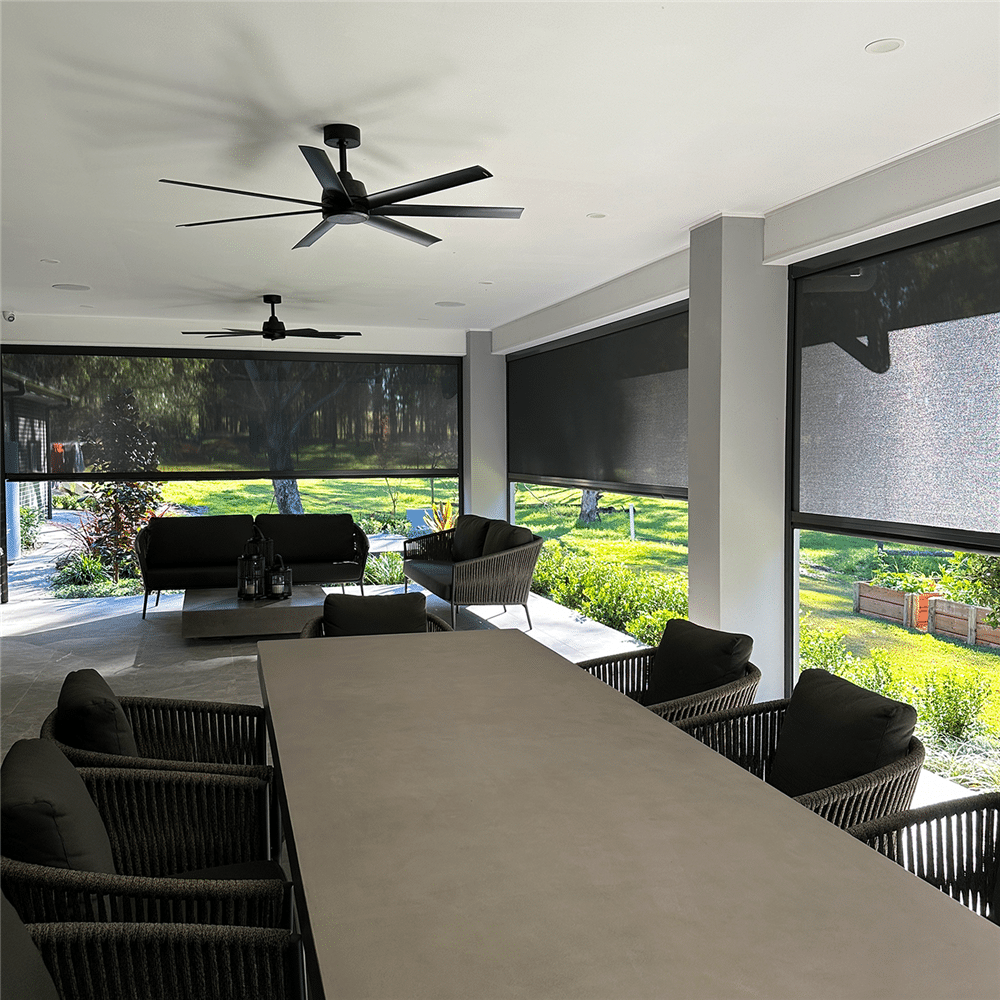
Urban density is pushing demand for external screens beyond the traditional 5% openness default. Three suppliers, Ricky Richards, HVG and Weinor Australia, explain what installers need to understand about performance, specification and the limits of what external screens can actually do.
Australia’s external screen fabric market has matured quickly. A product category that spent years at the margins of the window furnishings offer has moved firmly into the mainstream, driven by a residential construction mix that now includes more apartments, townhouses and dual-occupancy builds than ever before. The demand is no longer just for shade. It is for privacy, architectural integration, climate performance and, increasingly, a sustainability story that holds up to scrutiny.
The 5% openness factor remains the volume leader, and likely will for some time. It balances solar heat gain reduction with airflow and view-through in a way that suits most residential situations. But the growth is happening elsewhere. Tighter weaves, blockout options and wider-width fabrics are moving from specialty lines into regular stock decisions. Fibreglass as a base material is gaining traction for dimensional stability reasons. Bio-based plasticiser options are available and commercially proven. Full PVC-free alternatives remain a gap for the mainstream market, though commercial-scale specification is beginning to shift.
For installers and retailers, this expansion of the category creates a more complex specification task. The default answer is less useful than it was. What follows is a supplier-by-supplier account of where the external screen fabric category sits in mid-2026, what is driving change, and what the trade audience needs to understand to specify with confidence.
Ricky Richards
Ricky Richards has built the Outlook range into one of the more comprehensive external screen fabric lines available to the Australian trade, spanning mesh, privacy and blockout options within a single family. The company reports clear movement in what installers are specifying.
On openness factor demand, Ricky Richards is direct: “Traditionally, the Australian market has been dominated by a 5% openness factor. This has long been considered the ideal zone, offering a significant reduction in solar heat gain while maintaining a clear connection to the outdoors.” The 5% remains a high-volume staple in the Outlook Mode range, the company tells WFA, because it balances 95% UV radiation block with airflow performance. But the growth story is tighter. “We are seeing a distinct shift toward ‘Extreme Block’ solutions. As urban density increases, privacy becomes a premium commodity. This has led to a surge in popularity for 1% openness and, increasingly, 0% blockout options.”
For retailers dealing with specifiers moving from internal blinds to external solar control, Ricky Richards frames the performance conversation around three pillars: visual, thermal and structural. The thermal logic is the critical first lesson. “Internal blinds stop light, but external screens stop heat before it reaches the glass,” the company explains. The energy management advantage is realised on the exterior of the building, not inside it.
On the visual side, colour choice has a result that surprises many first-time specifiers. “A darker fabric in the Outlook Mode range will provide better view-through clarity and glare reduction than a lighter colour, which can create a veil effect,” Ricky Richards tells WFA. Thermally, the reverse applies: lighter colours reflect a higher proportion of solar radiation from the building skin. The installer’s job is to establish which property the client is prioritising before recommending a colour.
For structural specification, Ricky Richards points to dimensional stability as the most consequential field variable. The Outlook range uses a high-tenacity polyester yarn coated with PVC. “This ensures the fabric won’t bag or sag under tension, a critical factor for side-retention or wire-guide systems,” the company says. Width is the other dimension that matters for large alfresco spans: Outlook Mode and Outlook Privacy are available in 320cm widths, which the company says allows for wide-span installations without joins in openings common in contemporary Australian residential architecture.
Certifications carry practical weight in this category. Ricky Richards highlights GREENGUARD Gold certification and Microban antimicrobial protection across the Outlook range, noting these are relevant in coastal and humid environments where mould and mildew resistance is a functional requirement.
On the sustainability side, Ricky Richards has integrated Dow Ecolibrium bio-based plasticisers across the Outlook range, replacing a portion of the petroleum-based content in the PVC coating. “By utilising the Dow Ecolibrium technology in our Outlook range, we offer a commercially viable middle ground,” the company explains. “It allows retailers to provide a high-performance PVC mesh that uses bio-based plasticisers, reducing the carbon footprint of the project while maintaining the 320cm width and 15-year warranty.”
The product development direction over the past year has moved toward texture and architectural tone. “We’ve moved beyond flat, solid colours into a more sophisticated architectural palette,” Ricky Richards tells WFA. Bi-colour weaves in the Outlook Textures and Outlook Designs ranges aim to replicate the look of natural textiles. The company frames this as a material story as much as an aesthetic one: “We are no longer just focused on what the fabric does, but how it is made.”
HVG
HVG distributes the Visiontex external screen range and a portfolio of Sattler products into the Australian market. The company’s account of where the category is heading aligns with the broader market picture, but its most useful contribution to this feature is a clear-eyed account of what external screens cannot do, and why that matters for how installers brief clients.
On openness factor, HVG confirms the familiar pattern: “5% openness remains the most popular choice overall. With the increase in apartment and townhouse builds we are seeing greater demand for 1% and privacy and blockout options.” The specialty lines that were once peripheral are now moving into broader stock consideration. “The continued growth of what were once specialty parts of our range,” HVG tells WFA. The company points specifically to Visiontex Extreme (privacy mesh), Visiontex Perform (wide width, 97% solar control) and Visiontex Glisse (fibreglass mesh) as lines that have shifted from niche to more broadly popular.
For installers new to the external screen category, HVG emphasises that fabric selection must satisfy two separate sets of requirements simultaneously. “The desired colour choice, the requirement for heat or light reduction, air flow and privacy all need to be established,” the company explains. “These objectives then need to be considered in tandem with the technical requirements of the project such as blind width, building type and orientation and the specific environmental conditions.” The discipline of separating client preferences from installation constraints before reaching for a product sample is the foundation of a good specification conversation.
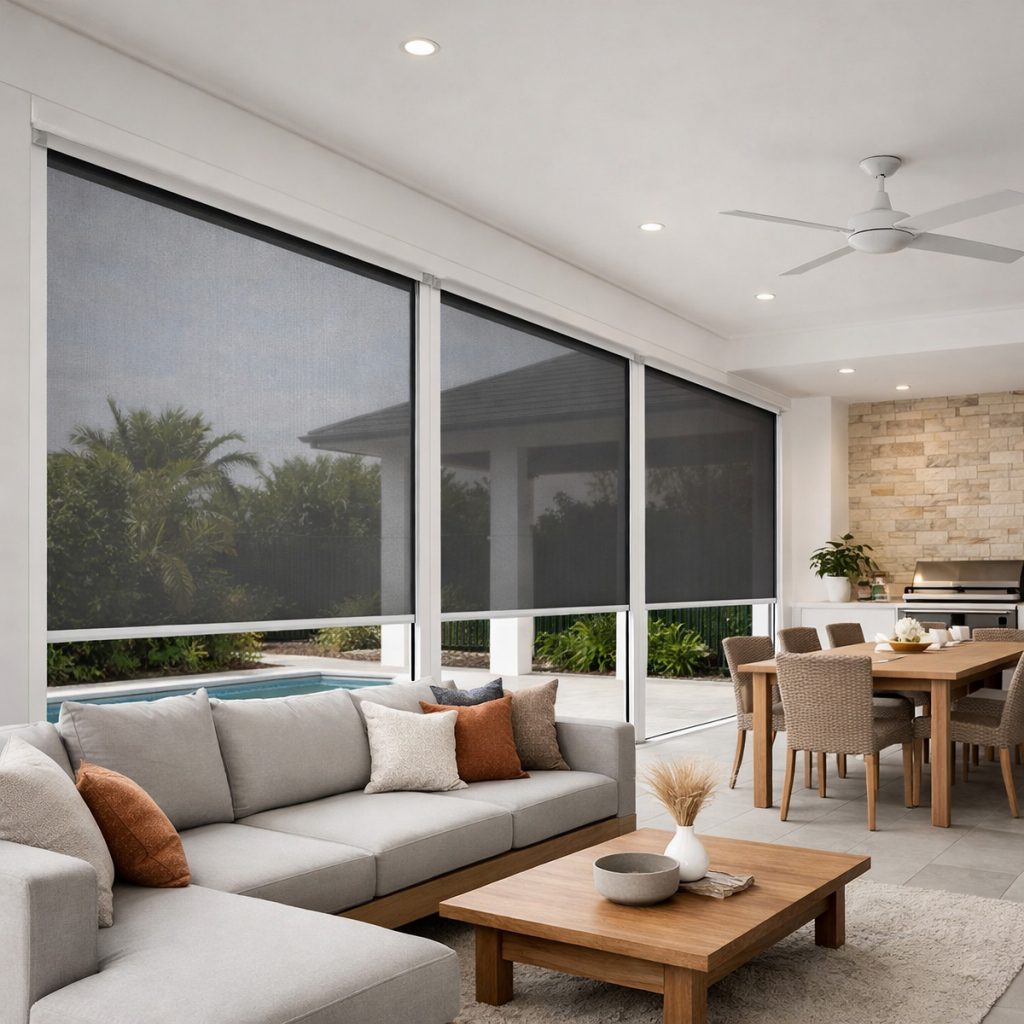
The most practically valuable part of HVG’s position, however, is its account of the misconceptions that cause the most damage to client relationships.
The first concerns water management. “Depending on the openness, sunscreen fabrics can prevent water ingress during a mild shower but will not offer protection during a major rain event,” HVG tells WFA. This is a distinction that matters enormously for how product capability is communicated at point of sale. An external screen is not a weatherproof enclosure, and framing it as one creates problems that arrive with the first heavy rain.
The second misconception carries a higher price tag. “External screens are often assumed to be wind breaks and are left down during high wind events, which can cause major damage to the screen,” HVG explains. This is fundamentally a handover and education issue. Proper installation sign-off must include explicit guidance on when screens should be raised. For motorised systems, integrating wind sensors removes the risk of client error.
A third area of concern is appearance change under environmental stress. HVG tells WFA that extreme temperature variation and exposure to dust and dirt can temporarily alter the way sunscreen fabric looks. “These changes rarely affect the performance of the fabric and can often be easily remedied through cleaning.” Managing this expectation at point of sale is straightforward, but needs to happen before the client notices the change and calls it a fault.
On the openness factor quality myth, HVG echoes a point the broader industry needs to communicate more consistently: “Most of the misconceptions relate to how external sunscreen fabrics perform in the extreme environments we experience in Australia.” A tighter openness factor is not a better openness factor. It is a different tool for a different problem, and recommending the right one requires understanding the project, not defaulting to specification habit.
On sustainability, HVG points to two specific developments in the Sattler range. The Cross Fibre range is manufactured from recycled yarn fibres and is offered at the same price as the standard Elements range, removing the cost premium that typically restricts uptake of recycled alternatives. Sattler’s Twilight Comfort, a PVC-free sunscreen, is beginning to appear in larger commercial specifications. HVG is candid about where the market sits: “There is still no commercially viable, PVC-free option for the broader consumer market.” That is an honest assessment for retailers fielding client sustainability questions, and it is more useful than an aspirational answer.
Weinor Australia
Meyer Blinds markets the Weinor fabric range into the Australian external screen category, with product offerings that include Starscreen, FibreGlass and the recently released Soltis Fibreglass range by Serge Ferrari. The range operates across the VertiTex II Vertical Awning system and Valance Plus applications, and according to Simon Meyer, Managing Director of Weinor Australia, the expansion of the range is a direct response to what the specification market is asking for.
Meyer identifies two primary fabrics doing the work in this category. Starscreen is constructed from spinneret-dyed polyester yarns, delivering UV resistance and colour stability within what the company describes as a softer, more textile-inspired aesthetic. Available in 12 curated colours, it has been designed to complement contemporary architectural finishes while providing privacy, glare reduction and outdoor durability. FibreGlass takes a different approach to base material: PVC-coated fibreglass yarns, which Meyer Blinds says provide high resistance to stretching, shrinking and distortion across varying climate conditions. Available in 20 colours, it maintains transparency while still delivering solar protection and privacy in applications where dimensional stability is a priority.
The newest addition to the Meyer Blinds external screen offer is the Weinor Soltis Fibreglass range by Serge Ferrari. “Designed to complement the existing FibreGlass offering,” Simon Meyer tells WFA, the Soltis Fibreglass range expands the available colour palette while retaining the performance characteristics expected of fibreglass screen fabrics. The expanded colour selection, Meyer says, addresses a growing specification priority: exterior fabric coordination across contemporary architectural projects where the screen is part of the architectural finish, not simply a functional product applied to it.
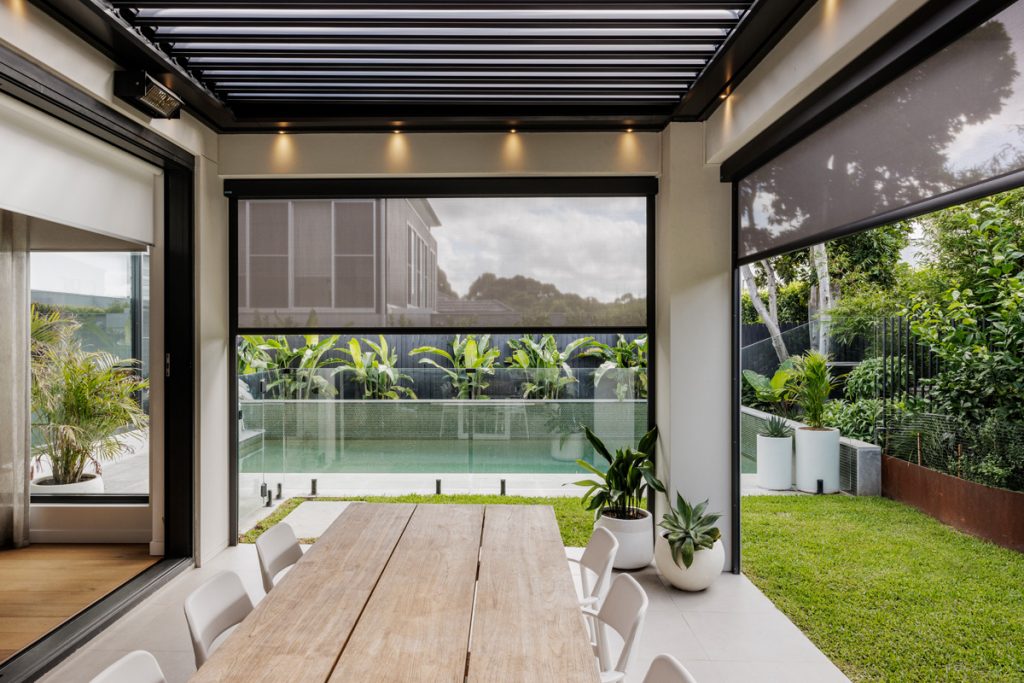
Colour alignment with exterior finishes is a consistent theme in Meyer’s account of what is driving specification decisions. “Neutral palettes and colours aligned with popular exterior finishes such as Colorbond continue to dominate specification across both residential and commercial projects,” he says. The demand is for products that read as part of the building, not as an accessory to it.
Beyond colour, Meyer points to sustainability and long-term durability as converging pressures on specification. FibreGlass construction, which resists stretching and distortion over years of exposure to Australian climate extremes, reduces replacement frequency over the life of the installation. The durability story and the sustainability story, in this reading, are the same story. A fabric that lasts longer across difficult conditions creates less waste and fewer call-backs, which benefits installers, retailers and clients equally.
See the latest from Weinor at Stand L4 at WSAA SuperExpo | 10–12 June.
Dalekit
In the mid-1990s, mesh was a problem, not a product. The polyester-core PVC screen fabrics arriving in Australia were difficult to cut, hard to tension, and nearly impossible to finish to a standard anyone in the trade was proud of. The material didn’t lay flat, its narrow widths limited what could be built, and the finished result showed every one of its shortcomings.
“The early mesh was a feeble comparison to what you could get from Europe,” says Joe Pajeska, owner of Dalekit Pty Ltd. “The European fibreglass-core PVC product was genuinely excellent, but the technology to work with it was incredibly expensive, and the fabric itself was priced out of reach for most of the Australian market.”
So the industry stayed anchored in canvas and acrylic. Mesh sat on the margins, occasionally specified, rarely celebrated.
The shift came with a single product. Vistaweave, a 2×2 layflat weave mesh imported from the United States (produced originally by Phifer who later dropped the Vistaweave range to produce Outlook), arrived in the Australian market and demonstrated something nobody had seen at an accessible price point: dimensional stability. Its regular interlocking weave distributed tension evenly across the surface, producing a fabric that lay flat on the workbench, cut cleanly, and held its shape in a finished installation.
“It was simply incredible compared to its competition,” Joe says. “The market had a distinct change. A new way of thinking about how awnings could be made in Australia was born from that moment.”
From the late 1990s into the early 2000s, the Australian awning market found its new default material. Canvas retreated. Acrylic found its natural home in folding arm awnings, where it remains today. The rest of the external screening market reorganised itself around mesh, and ultrasonic welding, which bonds PVC-coated mesh at a molecular level, became increasingly standard as volumes justified the investment.
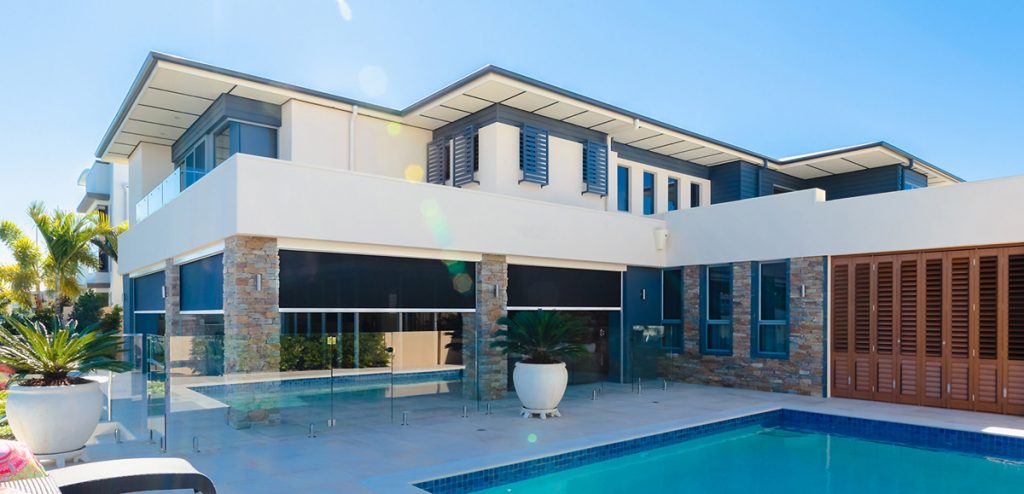
Today, the primary variable in external screening is no longer material type, it’s openness factor. The residential standard of 94 to 95 percent openness is well established, but the market is moving steadily toward lower figures. One percent openness fabrics are growing in specification, driven by clients wanting privacy and glare elimination without the weight and moisture sensitivity of canvas. Zero percent openness, fully opaque coated mesh, is crossing from premium to mainstream, directly displacing canvas in applications where canvas was once the only option.
“Canvas is a limited product now,” Joe says. “Mesh is everywhere else, and zero openness is changing what ‘everywhere else’ means.”
Dalekit has worked with every significant external screening fabric in the Australian market across its three decades of operation. The position the company has arrived at is one Joe describes not as a supplier preference, but as a conviction earned through experience and volume.
“There is an old John West advertisement: ‘It’s the fish that John West rejects that makes John West the best.’ That is the Dalekit philosophy. We can make anything out of whatever fabric a client specifies, and we will make it well. But when you ask what we would put on our own homes, when price is not the factor and everything else is equal, the answer is Outlook mesh from Phifer. Every time.” This is why Dalekit pricing is worked on Outlook Mode as the standard Mesh pricing in their products.
Outlook leads Dalekit’s internal performance rankings across the metrics that matter most: consistency roll to roll, field performance under sustained UV exposure, and what Joe simply calls serviceability, a quality that only reveals itself fully after years of high-volume production.
The relationship with Ricky Richards, Dalekit’s supplier for Outlook mesh, runs the full length of the business’s history. “It is a partnership born of mutual respect, not necessity,” Joe says. “We have alternatives. We have tried them. We choose Outlook because it is the best product for our application, and we choose Ricky Richards because they take that responsibility seriously. Those are two separate reasons and both matter independently.”
Joe is straightforward about the commercial reality. Dalekit is not the cheapest option, and it has never tried to be. Manufacturing in Sydney, with Australian labour and Australian standards, carries a cost, and a quality, that offshore production cannot replicate, “We are not the cheapest, and we cannot ever expect to be. But we offer a service, a lead time, and a quality that is second to none. And when you ask us what we would put on our own homes, you will have Outlook on the house.”