
Please turn your device to portrait.
Under the proposed model, experienced staff would take a compressed update and go straight to assessment, holders would appear on a public register, and WSAA would keep supporting the Cert III. WSAA hopes to present the framework to members in Melbourne in March.
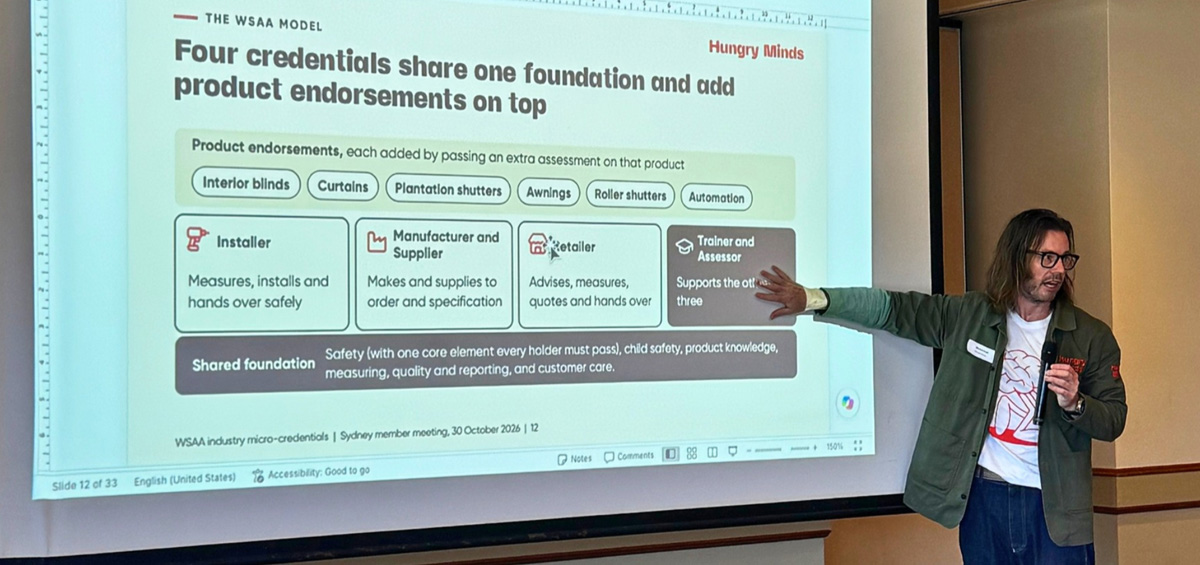
WSAA plans to offer its own industry-owned micro-credentials, with one proposed each for installers, for manufacturers and suppliers, and for retailers, plus a fourth for trainers and assessors.
Wesley Fawaz, Chief Executive Officer of WSAA, and Michael Peart, Managing Partner of Hungry Minds, presented the proposal at the association’s member meeting in Sydney on 30 October, where member tables workshopped the draft. Hungry Minds, a learning consultancy, is working with WSAA, and Peart said the session was its first work with the association.
Peart told members his father ran “a little sort of a side hustle business called After Hours Blinds”, where the family made vertical drapes in the garage and Peart and his brother installed them around the northern suburbs of Melbourne.
The proposal remains in its early stages, with key details of the credentials yet to be determined. “At the moment it’s a blank piece of paper, we don’t know what it’s going to look like,” Fawaz said. The installer credential handout distributed to members was marked “draft for discussion”, and Peart emphasised that the structure presented was a working model intended to guide feedback and consultation.
Feedback started at the Sydney meeting, Fawaz said, with online sessions to follow in November. WSAA will then develop a framework, which Fawaz hopes to present at the members’ meeting in Melbourne in the first week of March. Stage two would bring industry subject matter experts in to write the content with Peart.
What a micro-credential is
Fawaz described micro-credential learning as “short, sharp, flexible and practical learning”. He added: “It might be an hour online, it might be a two to three day in-person learning.”
Peart pointed to the government’s National Microcredentials Framework, which defines a microcredential as “a certification of assessed learning or competency, with a minimum volume of learning of one hour and less than an AQF award qualification, that is additional, alternate, complementary to or a component part of an AQF award qualification”. AQF stands for the Australian Qualifications Framework. He said the framework lists industry and professional associations as issuers and that WSAA needs no approval in its own right to issue them.
“WSAA’s credentials will be industry credentials, they won’t be nationally recognised,” Peart said. He added that they are not a full qualification or a licence. Full qualifications such as apprenticeships and Cert IIIs or IVs “can often take 18 months, two years to do”, he said, but micro-credential candidates “won’t have to leave the job for six months or attend TAFE one day a week for a year”.
The Cert III and cost
Fawaz said the credentials will be “a complement to the Cert III”, the nationally recognised MSF30926 Certificate III in Shading and Security Screens, and that WSAA will keep supporting it. He called them “another offering that the industry association can own and manage and run itself for the industry”.
Asked from the floor how the credentials relate to nationally accredited qualifications, Peart said they sit to the side and are not formally linked.
Cost was also raised from the floor. Peart said costs are for the association to work out, and that micro-credentials are often more obtainable because they are shorter and more compact. He said making something the industry can afford is usually part of an association’s thinking.
How the credentials are structured
Each credential is proposed to rest on a shared foundation: safety, child safety, product knowledge, measuring, quality and reporting, and customer care.
Three role credentials would sit on top. Peart summed up the installer as someone who measures, installs and hands over safely, the manufacturer and supplier as supplying orders to specification, and the retailer as advising, measuring, quoting and handing over.
The current thinking, Peart said, is to add product endorsements on top, so nobody is forced through material they do not make or sell.
The fourth credential would cover trainers and assessors, designed to a WSAA standard. Peart said WSAA-approved assessors and trainers are part of the model, and without them the system can lack credibility and rigour.
The proposed path is the same for each credential: prepare, perform, pack up and report. The credentials teach principles and the manufacturer’s instructions supply the product detail, Peart said. In his example, an installer must check the substrate is clean and suits the fixing, but the bracket, screw and technique depend on the product.
Three routes to a credential
For new and developing staff, Peart envisaged a short online course, potentially a practical day, and then evidence collection towards assessment. The practical day could be public, with people from different organisations, or in-house: a larger member could put ten installers through in a day.
Established staff would take compressed e-learning, a quick update on what is new, and go straight to assessment, proving competence with an evidence packet. Peart said the proposed model includes a fast-track or recognition element for people with industry experience.
The third route is a fallback for people who do not fit neatly into the other two, including those in regional or remote areas: a possible roadshow, or the online component plus an evidence packet of phone video of an installation and a statement signed by their employer and/or a customer.
Peart proposed one assessment model and one standard whichever route is taken. Assessment is on real work, he said, and “that real work has to be at the standard that the WSAA accepts or lays down”.
Renewal
Renewal is undecided. For installers, for example, Peart said the options include re-accreditation every two years, every three years, or when a major new product category arrives. Tables were asked to write a renewal period on their posters.
Asked whether the model would follow continuing professional development (CPD) in other industries, Fawaz said: “We probably won’t go down the CPD track, not initially”. WSAA will have some sort of refresher element, he said, for people who want to keep their certification current.
Register and benefits
A public register of credential-holding organisations and people is proposed, Peart said, so anyone can check before they buy. Over time, he said, WSAA could develop a mark or logo that consumers come to recognise.
For businesses, Peart said, a credential shows who holds one, and well-trained, well-assessed staff working at the right level tend to be safer and good at their jobs, which means “less call backs, less mismeasures”. Credentials ready to go also let a business onboard staff faster, he said, and could tip a sale towards a business that holds one over a competitor that does not.
For staff, a credential is proof of what they can do, and a wider range gives people a career path, Peart said: “you might start with the installation one, with a badge for blinds, and then you might take that to curtains, to the solar, to the external”, and staff can collect them as they go.
For customers, Peart said, a credential and the proposed register show who has been tested, and the core safety content, such as installing cords for child safety, is another measure.
For the industry, Peart said, “it’s a standard the trade can point to. It will boost your reputation over time, and it’s skills that can keep up with products.” He said WSAA’s history, dating to 1947, adds weight.
Speed and precedents
Peart said industry credentials can change quickly: in nationally recognised systems “something that might seem simple can take months if not years to change”, while WSAA can add a credential “as quickly as we need to do it”.
Fawaz, formerly Executive Officer of the Australasian Corrosion Association, said that body ran a suite of micro-credential learnings and put up to a thousand students a year through short courses, which “helped us grow membership, helped us lift our profile and our importance within the industry”. He said WSAA wants to start offering the same in the window coverings industry.
Peart named the Master Glazier program, solar accreditation and insulation as other examples.
Future credentials
The first workshop activity asked tables to sketch credentials the program could add later: what the role would look like, who would take it and how many people in the industry that would be. Ideas listed included large commercial jobs, energy performance and updates as rules change.
The briefing acknowledged that larger, more complex supplier and manufacturer businesses may need a wider mix. Tables were told a credential with only two people in the industry might not be the best use of time.