
Please turn your device to portrait.
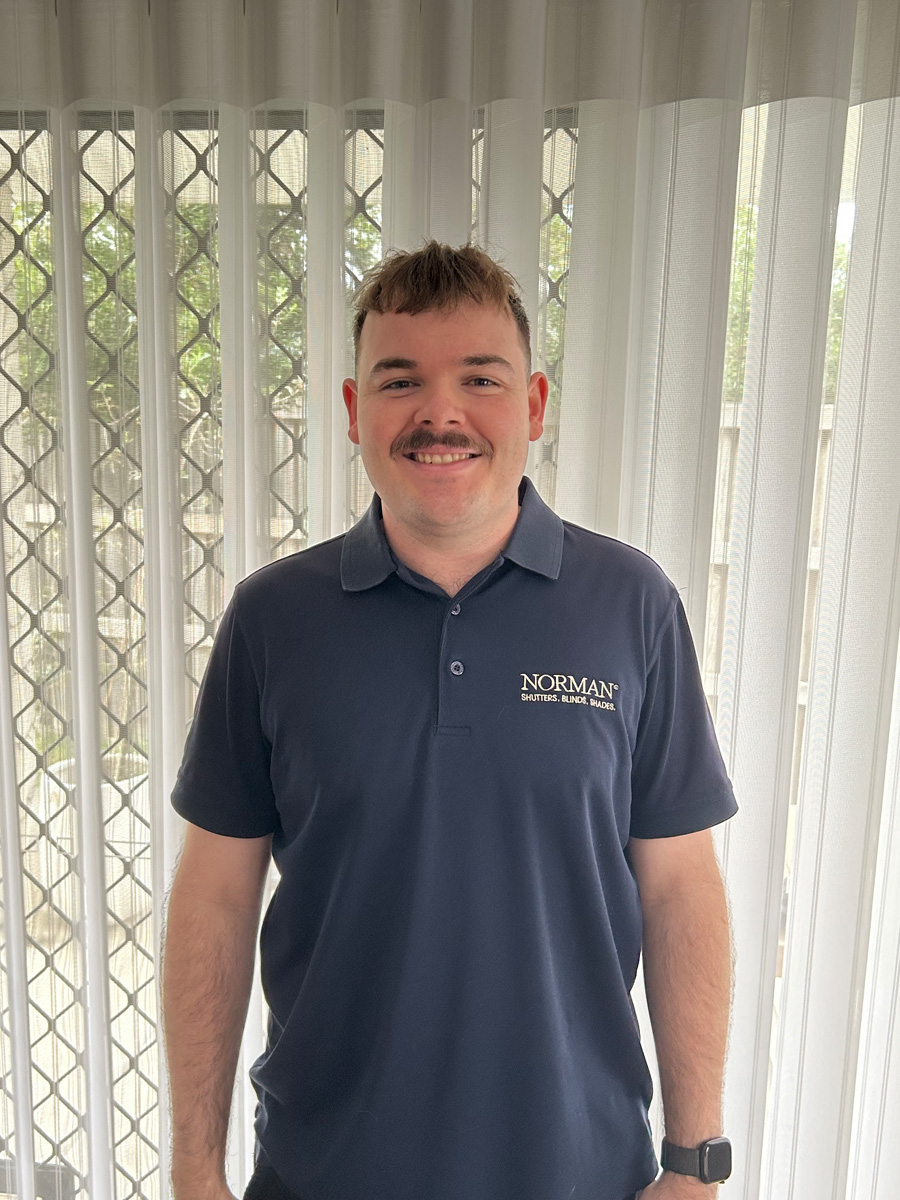
A service-first instinct and an openness to being pushed have taken Kyden Camilleri from car sales to Business Development Manager at Norman Australia in just four years. Window Furnishings Australia (WFA) caught up with this industry rising star to hear about his journey in the industry so far.
Kyden Camilleri was not shopping for a career in window furnishings. He had spent three years in car sales when a recruiter rang, interested in his sales background and looking to put him forward for a different role altogether. Norman Australia came up almost as an aside. “The recruiter had another sales role lined up for me, but when they mentioned Norman I was far more interested,” he says. “The customer service side appealed to me more, so that’s the path I chose.”
It was, by his own admission, a stroke of luck. “It was luck of the draw finding my way into the window furnishings industry.” But the person who arrived at Norman four years ago, curious about the service side of a shutters-and-blinds business, is not quite the same one who sits in the Business Development Manager’s chair today. “Never did I think I’d care so much about shutters, blinds and shades,” he says, “but here I am four years later, not wanting to be anywhere else.”
That candid affection for an industry most people only think about when they’re renovating speaks to something Camilleri returns to often: the gap between what window furnishings looks like from the outside and what it actually takes to do it well.
When he joined Norman, he moved into customer service and spent three and a half years there. The experience shaped him, but he credits the people around him most directly. “Everything I know today has come from someone on the Norman team,” he says, “and I really appreciate the staff who took me under their wing.” One person in particular stands out. Shannon, whom Camilleri describes as Norman’s Business Operations Manager, worked alongside him in customer service throughout that period. She spotted something in him and, by his account, refused to let it sit idle. “She has always pushed me to want more and to not settle,” he says. After three and a half years together in the team, she finally convinced him to step into the BDM role. The support did not end at that transition. “Since stepping into the role she’s continued to provide amazing support. I know she’ll always have my back.”
The shift into business development changed the texture of Camilleri’s working week considerably. Three days on the road visiting retailers, two back at the desk managing calls and emails: that is the frame he works within, though regional travel regularly reshapes it. “Regional travel is what really shakes up my week, in a good way,” he says. “It means visiting as many retailers as possible, trying to spend quality time with each one, usually with long drives in between.” When he is out seeing regional customers, Norman’s customer service team picks up the overflow, giving him the space to focus on the people in front of him.
The bigger shift, though, is not logistical. It is a change in how he thinks. In customer service, the job was to answer whatever question arrived. Now he finds himself asking a different kind of question entirely. “In customer service, I’d answer whatever question needed answering. Now I find myself asking why. Why does the customer do it that way? How can we order it differently to make it easier for the installer?” That move from reactive to proactive, from solving problems as they arrive to anticipating them, is what he describes as the defining change in how he approaches the work. There is also the matter of accountability. Complex queries used to be escalatable. “Not being able to pass something above my skill level on to the BDM, because I am the BDM now,” he says, is something he has had to reckon with. He leans on Norman’s product development manager and team of technical and product specialists when he needs to, but the primary responsibility is his.
That responsibility sharpens quickly once you understand what the role demands of a person’s memory. Camilleri believes the sheer depth of product knowledge required in window furnishings is the most underestimated thing about working in the trade. program binders hold the technical specifications for everything, but, as he notes, no one tells you how much of it you actually need to carry in your head until you are standing in a customer’s home. “When we walk into a home, we’re thinking about reveal depths, louvre clearances, lift systems, light control, deductions, airflow, and how to fit all of that into a single window furnishing.” The margin for error is narrow. His approach to navigating it: take the extra minute, check the binder, make the call. “Customers would much rather wait to hear the correct answer than get an answer straight away that might not be 100% right.”
On the broader trajectory of the industry, Camilleri holds a clear-eyed and, in places, urgent view. Motorisation and home automation, he believes, will soon be the number one lift system sold across the trade. He points to the way operating systems have become easier to use, safer for families, and more aesthetically pleasing over time, and argues that motorisation now brings all three qualities together. “During this shift, retailers need to get on board now, before it’s too late,” he says. That, in his view, means having the products available, but also training staff on operation, reprogramming, and third-party integration. “It’s only a matter of time before our customer base is fully up-skilled in this category, and it’s our job to be ready for it.”
The post-COVID building and renovation boom has, in Camilleri’s view, driven real momentum into window furnishings. He does not see that growth slowing. His concern sits elsewhere. “The only negative I can see that could hurt our industry is a price war,” he says, “understanding that you may not always be the cheapest, but quality will always prevail.” The corrective, as he frames it, is a matter of discipline. “We must continue to innovate, create and never compromise on quality.”
For anyone walking into a window furnishings business as a trainee or new sales rep, Camilleri’s advice strips the industry back to its simplest principle. “People will always buy from people,” he says. “Being kind, compassionate and providing exceptional service will take you where you need to go in this industry.” In five years, he hopes to still be in the trade, building alongside his retailers and watching their results translate into his own. “Their growth is my growth,” he says, “and seeing my retailers succeed gives me a lot of satisfaction.”
The honeymoon phase, he adds, has not faded. The person who arrived at Norman out of curiosity about the service side of a business he knew nothing about is still, four years on, genuinely surprised by how much he means it. “The honeymoon phase hasn’t left me in this role,” he says. “I genuinely enjoy what I’m achieving so far.”